
A preparação de nanopós Os métodos químicos são geralmente categorizados em métodos físicos e métodos químicos. Abaixo, segue uma lista comparativa detalhada destacando suas características:
Tabela comparativa: Física vs. Síntese química de nanopós
|
Recurso
|
Métodos físicos (de cima para baixo)
|
Métodos químicos (de baixo para cima)
|
|
Princípio básico
|
De cima para baixo: Materiais em massa são decompostos em nanopartículas usando energia física (mecânica, térmica, etc.).
|
De baixo para cima: Átomos, moléculas ou íons são reunidos em nanopartículas por meio de reações químicas.
|
|
Técnicas típicas
|
Moagem mecânica com esferas, evaporação térmica/a vácuo, ablação a laser, processamento por plasma, pulverização catódica.
|
Processo sol-gel, síntese hidrotérmica/solvotérmica, precipitação química, microemulsão, CVD.
|
|
Controle do tamanho das partículas
|
É difícil obter um controle preciso. Geralmente resulta em uma ampla distribuição de tamanhos.
|
Alta precisão. O tamanho e a morfologia podem ser ajustados através da variação do tempo de reação, do pH e dos surfactantes.
|
|
Pureza e homogeneidade
|
Alto risco de contaminação por meios de moagem (na moagem). Os métodos de vaporização física proporcionam alta pureza.
|
Alta homogeneidade química em nível molecular. No entanto, precursores ou subprodutos podem permanecer como impurezas.
|
|
Morfologia (Forma)
|
As partículas geralmente têm formas irregulares ou aleatórias.
|
Altamente personalizáveis (esferas, hastes, tubos, lâminas, etc.) através do controle da cinética de crescimento.
|
|
Custo
|
Alto custo de equipamentos (ex.: lasers, sistemas de vácuo), mas utiliza matérias-primas a granel mais baratas.
|
Baixo custo de equipamentos (para métodos baseados em soluções), mas alto custo para precursores puros e solventes.
|
|
Escalabilidade
|
Métodos como a moagem de bolas são muito fáceis de serem dimensionados para a produção industrial em massa.
|
Aumentar a escala de produção é um desafio, pois manter condições de reação uniformes (aquecimento/agitação) é difícil em grandes volumes.
|
|
Dispersão
|
As partículas tendem a se aglomerar fisicamente; baixa atividade superficial durante o processamento.
|
Uma melhor dispersão pode ser obtida adicionando agentes estabilizantes ou surfactantes durante a reação.
|
|
Impacto ambiental
|
Geralmente mais "ecológico" (sem solventes), mas consome muita energia e é ruidoso.
|
Impacto ambiental significativo devido ao uso de solventes orgânicos, ácidos e resíduos químicos tóxicos.
|
Além disso, também pode ser utilizado um método de preparação misto que combine os dois.
(1) Método de condensação por evaporação sob gás inerte
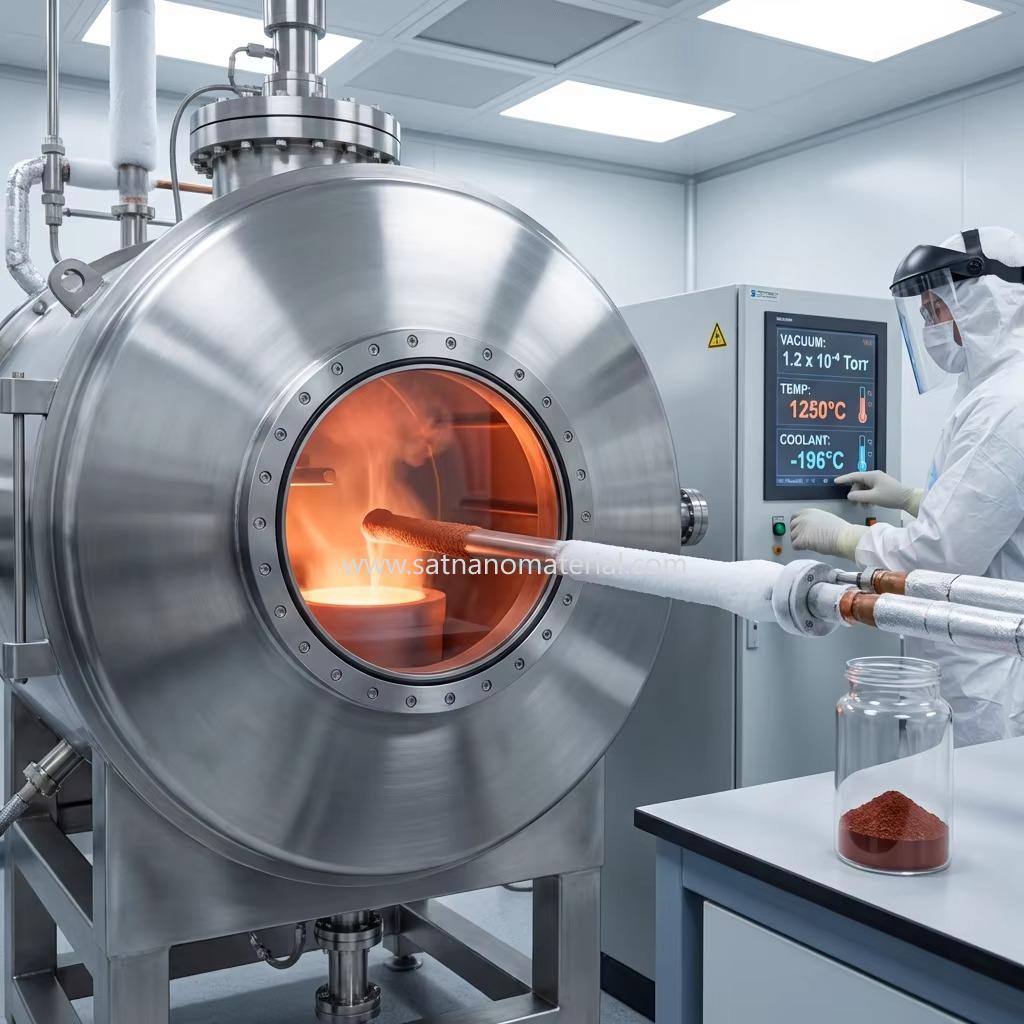
Geralmente, é formado por partículas com superfícies limpas e tamanhos entre 1 e 100 nm sob alta pressão, o que também é necessário para o processo de sinterização de nanocêramicas. Diversos nanomateriais sólidos têm sido sintetizados com sucesso, tanto nacional quanto internacionalmente, utilizando técnicas como evaporação em gás inerte, incluindo metais e ligas metálicas, cerâmicas, cristais iônicos amorfos e semicondutores.
Yan Hongge e colaboradores estudaram as alterações na taxa de evaporação do metal, no rendimento, no tamanho das partículas e na morfologia de pós ultrafinos, variando os parâmetros do processo de evaporação. Eles projetaram e pesquisaram um dispositivo de preparação de pós ultrafinos, que fundia e evaporava o metal em um cadinho sob pressão de gás argônio de 50 a 1000 Pa, utilizando aquecimento por indução de média frequência, e capturava o pó através de um solenóide resfriado a água, obtendo, por fim, pó de cobre fino de 180 a 560 nm.
(2) Método hidrotérmico
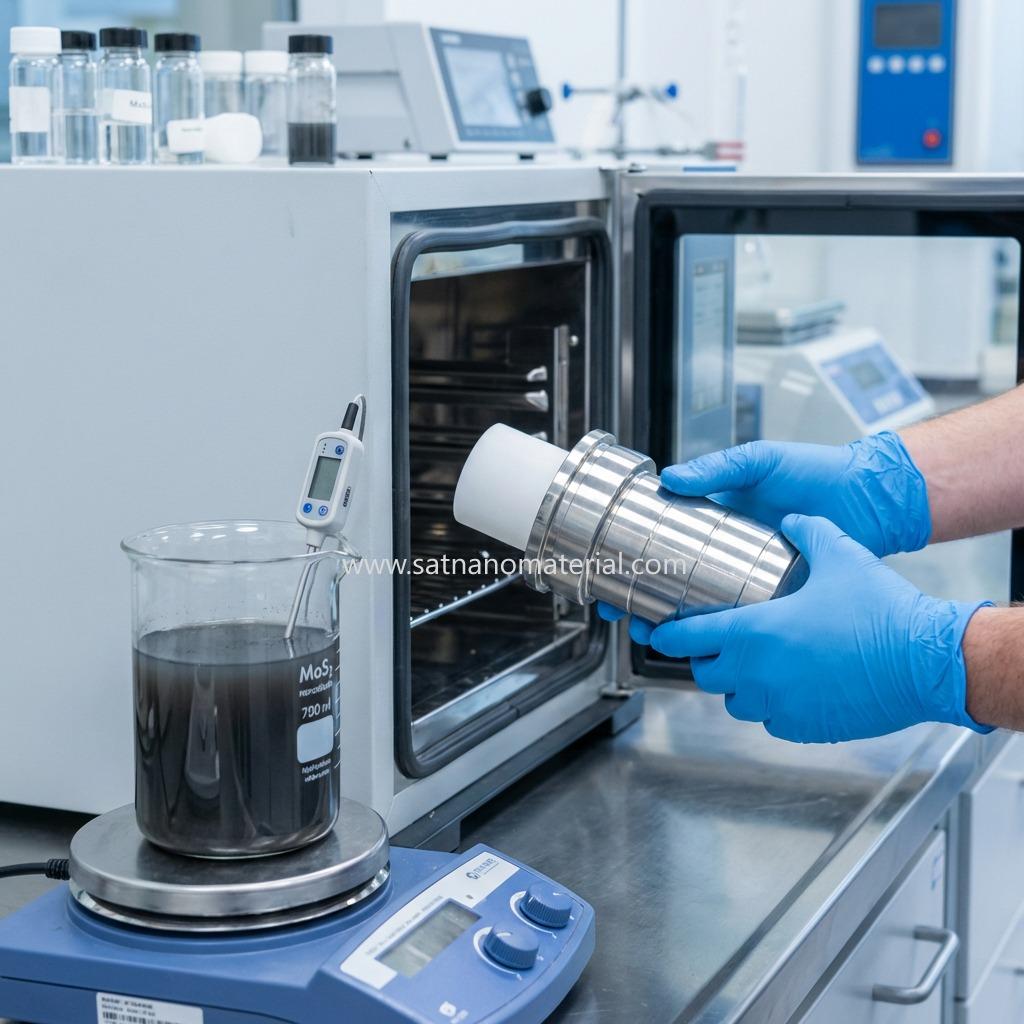
O método hidrotérmico é geralmente utilizado para sintetizar nanopartículas em sistemas fluidos, como soluções aquosas ou vapor, sob condições de alta temperatura e alta pressão, seguido de separação, tratamento térmico e outras operações. O método hidrotérmico é um processo simples, econômico, não poluente e com baixo consumo de energia, adequado para produção industrial.
Liang et al. sintetizaram uma nanoestrutura anfipática de dissulfeto de molibdênio (KH550-MoS₂) pelo método hidrotérmico. A concentração ultrabaixa do nanofluido KH550-MoS₂ reduziu a tensão interfacial (TIF) para 2,6 mN/m, alterou seu ângulo de contato de 131,2° para 51,7° e melhorou significativamente a estabilidade da loção. Através de experimentos de deslocamento de núcleo, o nanofluido KH550-MoS₂ em concentração ultrabaixa aumentou a eficiência de deslocamento de óleo em 14% após a inundação com água.
(3) Método de decomposição complexa
O método de dupla decomposição refere-se ao método de preparação de nanopartículas pela reação de sais de íons metálicos facilmente solúveis (como CaCl₂, MgCl₂, etc.) com sais facilmente solúveis (como NH₄HCO₃ ou Na₂CO₃, etc.) sob condições de processo apropriadas, a uma determinada temperatura, valor de pH e outras condições de reação. Na reação, regulando-se a concentração dos reagentes, a supersaturação das nanopartículas e estudando fatores como a concentração e o tipo de agentes de controle de cristalização, é possível obter nanopartículas com diferentes tamanhos, distribuições de concentração e diversas morfologias.
Nas últimas décadas, um grande número de pesquisadores adotou o método de decomposição complexa para preparar nanopartículas de carbonato de cálcio. A distribuição do tamanho das partículas de nanocarbonato de cálcio preparadas pelo método de dupla decomposição geralmente varia entre 20 e 100 nm. Zhao Lina utilizou o método de reação de precipitação de sais solúveis e ácido poliacrílico como agente controlador de cristalização para preparar partículas de carbonato de cálcio com formato de aragonita em forma de borboleta, com morfologia específica, controlando fatores como temperatura e pH.
(4) Método de microemulsão
Dois solventes imiscíveis formam uma loção sob a ação de um surfactante e precipitam nanopartículas sólidas a partir dessa loção. Chen Liping et al. utilizaram os três componentes de uma solução aquosa de CTAB/ciclohexanol/sal correspondente para formar três sistemas de microemulsão típicos: O/A (óleo em água), A/O (água em óleo) e um sistema bifásico contínuo óleo-água. Os resultados indicam que, no sistema A/O, a nucleação e o crescimento dos cristais de BaSOx são limitados a núcleos de água de tamanho fixo, resultando em partículas cúbicas ou retangulares de 15 nm; no sistema bifásico contínuo óleo-água, o óleo e a água formam uma estrutura em rede, resultando em partículas com tamanho aproximado de 700 nm. À medida que a concentração de sal aumenta gradualmente, a forma das partículas começa a mudar de "espinhos de peixe" para formas de flor; no sistema O/A, o tamanho das partículas é de aproximadamente 1 μm e, com o aumento da concentração de sal, o tamanho das partículas aumenta e a morfologia muda de forma de flor para "espinhos de peixe". Diferentes sistemas de microloção têm efeitos distintos no tamanho e na morfologia das partículas de BaSO₄.
Ding Yang e outros não só conseguem obter um sistema de microemulsão ecologicamente correto, como também melhoram a dispersão da fase dispersa no sistema de microemulsão alterando o tipo de cossurfactante, o que não só inibe eficazmente o crescimento das partículas de CaCO3, como também controla a direção de crescimento dessas partículas e tem um efeito regulador no tamanho das nanopartículas de CaCO3.
A SAT NANO é uma das melhores fornecedoras de nanopós na China e podemos oferecer... pó metálico , pó de liga , pó de carboneto e pó de óxido Se tiver alguma dúvida, entre em contato conosco pelo endereço admin@satnano.com.


 serviço on-line
 13929258449
 admin@satnano.com
 + 8613929258449


